
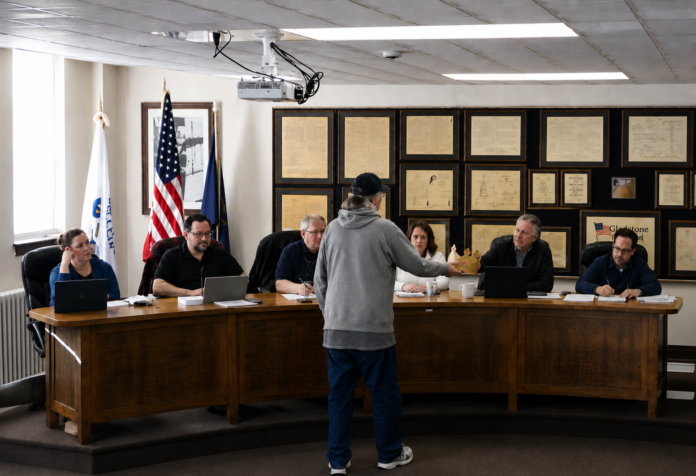
GLADSTONE — Gladstone residents showed up at Monday’s City Commission meeting concerned about what they say has become one of the city’s more persistent expenses: lawsuits filed by longtime City Hall adversary Michael “Citizen Mike” O’Connor. O’Connor currently has five new lawsuits pending against the city, continuing a legal and political fight that has stretched across the better part of a decade.
Resident Jeff Waeghe came prepared, telling commissioners he had written his comments down because sometimes when he gets angry, he tends to “go off.” His concern was a figure he said had already been spent responding to lawsuits over the years: half a million dollars. “Just think what that half a million dollars would purchase,” Waeghe said, later adding that “half a million dollars will get a lot of things done.” He wanted people outside the commission chambers to hear about it, too, specifically asking the Daily Press to publish his comments.
The Daily Press did, in fact, report on Waeghe’s comments later in the week, but since he specifically requested press coverage, The Daily Pasty sees no reason to leave the poor man with only one newspaper. Another resident followed Waeghe and said she was surprised people weren’t “up in arms” over what she characterized as frivolous lawsuits. She said she was willing to pay for police, fire protection, garbage collection, municipal water and the infrastructure necessary to provide those services, but she was no longer willing to pay “court costs, attorney fees, or staff time” for what she considered unfounded litigation.
The $500,000 figure should be treated as an allegation rather than an audited total. It was raised by residents and discussed during the meeting, but The Daily Pasty has not independently reconstructed Gladstone’s legal bills over the past decade, and O’Connor himself has challenged the figure and asked the city to substantiate it. What is considerably easier to establish is that O’Connor and Gladstone City Hall have been doing this for a very long time.
O’Connor, a former city commissioner, has spent years challenging Gladstone government through lawsuits, petitions, mailers and public comment. An earlier round of litigation ended in a 2018 settlement. By then, the city reported that its legal expenses connected to the disputes had exceeded $200,000. Neither side admitted wrongdoing, O’Connor dismissed his cases, the city dismissed its case against him, and the city agreed to pay $35,000 into a trust account for O’Connor’s attorney.
The disputes continued, particularly over Gladstone’s use of special assessments. Eventually O’Connor took that argument out of the courtroom and directly to voters, helping put a charter amendment on the 2024 ballot that eliminated the city’s ability to use special assessments for public improvements. About 67 percent of Gladstone voters approved it. That victory is an important wrinkle in the current fight: it would be easy to characterize O’Connor simply as the guy who keeps suing Gladstone, but at least once he managed to convince roughly two out of every three voters that Citizen Mike had a point.
That success did not result in Citizen Mike quietly retiring from municipal government criticism while everyone shook hands and agreed it had been an interesting few years. By March, he was back. O’Connor appeared at the March 9 commission meeting with a mailer called “Citizen Mike Volume Two,” arguing that the city had improperly imposed special assessments in previous years. He also challenged Gladstone’s use of Public Act 33 for police and fire funding and alleged that the city improperly transferred millions of dollars from utility funds toward retirement obligations. O’Connor said information had been provided to Michigan State Police and the Attorney General and told commissioners he hoped they would eventually be found guilty of misconduct in office and removed.
The exchange became considerably less municipal when O’Connor tried to get Mayor Joe Thompson to respond during public comment. Thompson reminded him that public comment was not a dialogue and that the commission was following its rules of procedure. O’Connor responded, “Yeah. You’re the king.” Thompson assured him that he was not, in fact, king of Gladstone.
Two weeks later, city officials used the March 23 meeting to push back against some of O’Connor’s claims. Commissioner Brad Mantela addressed the Citizen Mike mailer, including an allegation that Gladstone was overcharging residents by roughly $1 million through its utilities. Mantela pointed instead to approximately $520,000 in audited shared costs for things such as city management, IT support, financial staff and infrastructure maintenance, saying those expenses were accounted for in the city’s audit.
The Public Act 33 issue was also drawing attention beyond O’Connor. At the same March 23 meeting, residents spoke both for and against the police and fire assessment, and commissioners noted they had received a number of letters on the subject. Gladstone’s position is that Public Act 33 provides state-law authority for the assessment; O’Connor argues the 2024 charter amendment restricting special assessments prevents the city from using it in the manner it has. That disagreement is now among the issues headed to court.
As spring progressed, the dispute moved from mailboxes and commission microphones into public-record requests. O’Connor filed Freedom of Information Act requests and challenged the fees associated with at least one of them. In one appeal, the city acknowledged it had made a rounding error under FOIA law and recommended refunding $78, while rejecting O’Connor’s broader argument that its charges were excessive.
Then O’Connor returned to a strategy that had worked for him before: putting the question directly to voters. On June 22, he submitted a citizen initiative petition seeking to let voters establish residential “readiness to serve” utility charges, proposing a $10 monthly fee per service for electric, water and wastewater and a $10 provision for solid waste. The city rejected the initiative after reviewing it with attorneys from Miller Canfield, arguing that setting utility rates is an administrative function reserved for the commission under the city charter and state law rather than something subject to citizen initiative.
And then came the lawsuits.
By late July, O’Connor had filed multiple cases challenging city actions, and by August the total had reached five. According to city officials and local reporting, the disputes involve several areas of city government, including the Public Act 33 police and fire levy, borrowing connected to water-system improvements and electrical transformers, and city financial reporting. Gladstone maintains that it has the legal authority to take the actions O’Connor is challenging, while O’Connor maintains that officials are violating provisions of the city charter.
The Daily Pasty has not obtained the five complaints themselves, so we are not going to attempt to decide which side has correctly interpreted several chapters of municipal law from the comfort of Pasty HQ. For now, that unfortunate responsibility will remain with the Delta County Circuit Court and the attorneys being paid to use phrases such as “pursuant thereto” without giggling.
At the August 10 meeting, city officials discussed the legal response to four of O’Connor’s cases, saying many of the same legal principles applied across the filings. During that discussion, officials relayed that the city’s attorneys had characterized O’Connor as a “serial filer harassing the City of Gladstone.” That is the attorneys’ characterization, not a finding by the court. Later in the meeting, City Manager Rob Spreitzer announced that the city had received the legal argument concerning O’Connor’s fifth lawsuit.
By commissioner comments, keeping track of the lawsuits was becoming its own municipal function. Discussion briefly referenced “five new ones” and then “six new ones” before someone corrected the count: “Well, we’re anticipating a six.” Commissioners also emphasized that the city does not have the option of simply ignoring litigation filed against it and said Gladstone must respond and defend itself.
That brings the story back to Waeghe and the residents who showed up Monday. Their concern was not simply whether O’Connor is right or wrong about any particular assessment, transformer or utility charge, but what the cumulative fight is costing the community and what else Gladstone could be doing with that money. During the August meeting, commissioners characterized O’Connor’s previous litigation as having produced little or no finding of wrongdoing against the city. O’Connor disputes the broader portrayal of his efforts as fruitless and has maintained that his actions are aimed at enforcing the charter and holding city government accountable.
The awkward reality is that both sides have something to point toward. Gladstone officials strongly dispute O’Connor’s current allegations and have defended the legality of the city’s actions. O’Connor, meanwhile, has already demonstrated that his complaints about City Hall can resonate well beyond the podium: when he asked Gladstone voters to restrict the city’s special-assessment authority in 2024, they overwhelmingly agreed.
Whether the latest five lawsuits establish violations of Gladstone’s charter or add another stack of legal invoices to a feud now approaching its second decade will ultimately be decided somewhere other than a City Commission meeting. Until then, Gladstone has five pending lawsuits, two sides convinced they’re protecting the taxpayers, residents asking what all of this is costing them, and a city that has apparently learned not to get too attached to the current count.
After all, they’re already anticipating six.