
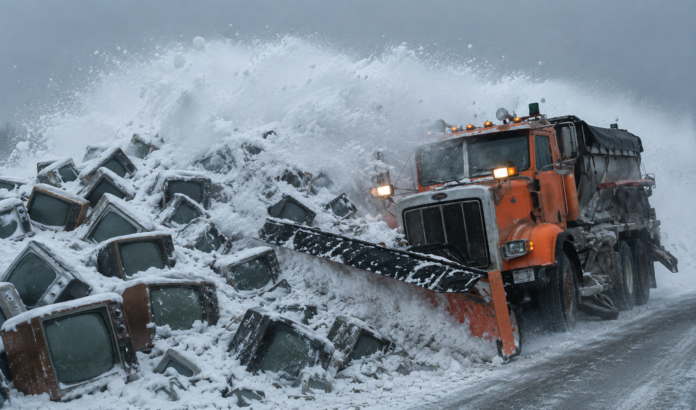
THE YOOP! – There are problems, and then there are Upper Peninsula problems. A pothole is a problem. A busted snowblower is a problem. Discovering a warehouse containing more than 1.2 million pounds of crushed television tubes is the sort of problem where somebody eventually has to stop, stare at the mountain of obsolete electronics and ask the fairly reasonable question: How in the hell did we get here?
The answer, according to the Michigan Department of Environment, Great Lakes, and Energy, is considerably more complicated than a bunch of Yoopers refusing to throw away their old Magnavoxes. For years, much of the U.P. simply didn’t have convenient, permanent places to recycle unwanted electronics. Old televisions are heavy, expensive to transport and full of materials you don’t particularly want smashed into the landscape. Combine that with a peninsula roughly the size of a small European country, scatter 300,000 people across it, and suddenly getting rid of Grandma’s 140-pound tube television becomes an exercise in rural economics.
EGLE revisited that problem this week while highlighting the electronics-recycling network that has since been built across the U.P. The agency traces much of the effort back to 2014, when it received a complaint involving an unregistered electronics recycler with televisions accumulating behind its business. That investigation eventually led officials to a warehouse containing more than 1.2 million pounds of crushed cathode-ray television tubes.
That’s 600 tons.
For perspective, at that point you no longer have “some old TVs.” You have achieved geology.
The mess ultimately required a federal cleanup. According to EGLE, the U.S. Environmental Protection Agency spent more than $1 million removing the material by 2020. EGLE electronics recycling specialist Steve Noble has said seeing that warehouse helped convince him that occasional collection events weren’t going to solve the U.P.’s electronics problem. The peninsula needed permanent places where people could bring this stuff before somebody accidentally assembled another sedimentary layer of Zenith.
And if 1.2 million pounds of television tubes sounds like the obvious high-water mark for this story, Menominee County would like a word.
In rural Daggett Township, a man identified by EGLE as William saw essentially the same problem from the other end. There weren’t many good options for disposing of unwanted electronics, and he figured he could make some extra money taking them from people. He and his wife advertised the service on local radio.
People brought televisions.
Then they brought more televisions.
Then, because human beings have a remarkable ability to interpret “we take old TVs” as “apparently this is now the county dump,” other things started appearing too. EGLE says the collection eventually included refrigerators, tires and assorted electronics, with discarded material stretching several hundred feet along both sides of the house and road.
Neighbors complained. The township, according to EGLE, didn’t have a blight ordinance it could use to force a cleanup, and the agency says the county did not respond. Eventually some of the electronics extended far enough toward the roadway that winter snowplows would strike discarded televisions, knocking them around and sending them back into the ditch and yard.
Read that again, because it may be the most Upper Peninsula sentence ever committed to government paperwork: there were enough discarded televisions along a rural road that they became a snowplowing issue.
Then the story stopped being funny.
On a cold November night, EGLE says a space heater ignited bedding inside the home. The fire spread, destroying the house and burning portions of the accumulated electronics outside. William’s wife escaped with their cats. William did not. He died in the fire.
What remained was a burned property surrounded by broken CRT glass, damaged television tubes, melted plastics and partially burned electronics. Federal officials evaluated the site, but sampling didn’t find contamination at levels that warranted an emergency federal cleanup. So the wreckage remained.
For two years.
And remarkably, according to EGLE, people continued dumping material at the property even after the fire.
Eventually the state secured funding for a cleanup, and the site was cleared in the spring of 2025. By then, the episode had demonstrated something that the million-pound warehouse already should have made fairly obvious: telling people to recycle electronics doesn’t accomplish much if the nearest practical recycling option is somewhere between inconvenient and nonexistent.
That’s the less ridiculous part of this story, and probably the more important one.
Electronics recycling is a lousy logistical proposition in a place like the Upper Peninsula. The distances are enormous, the population is sparse and an individual collection site may take a long time to accumulate enough material to economically fill a trailer. A dead television in Marquette isn’t especially valuable when somebody has to pay to haul it hundreds of miles before anything useful can happen to it.
So EGLE and its partners started building a system around that reality rather than pretending the U.P. operates like suburban Detroit.
The state has worked with local governments, tribes, environmental organizations, businesses and recyclers to establish permanent electronics collection sites around the peninsula. According to EGLE’s latest update, the U.P. now has nine permanent collection locations along with three retailer collection sites, supplemented by periodic collection events.
And Yoopers are using them.
EGLE says permanent collection sites took in more than 120,000 pounds of electronics during 2025. Collection events gathered nearly another 100,000 pounds. The agency says the amount being collected through those programs has been increasing by nearly 15 percent annually.
That is a lot of dead laptops, monitors, printers and televisions that aren’t sitting behind somebody’s barn waiting to become a future government case study.
It’s also one of those rare government stories where the sequence of events makes a certain amount of sense. A problem appeared. The problem became enormous. The problem became expensive. Another version of the problem appeared somewhere else and ended tragically. Eventually somebody concluded that perhaps relying on people to individually figure out what the hell to do with obsolete electronics in one of the most geographically inconvenient parts of Michigan wasn’t much of a waste-management strategy.
So now there’s an actual network.
It isn’t glamorous. Nobody is cutting a ribbon in front of a pallet of discarded Dell monitors while a marching band plays. Electronics recycling probably won’t dominate conversation at the bar Friday night. But the next time a 30-year-old television finally gives up and leaves somebody staring at 100 pounds of useless glass and plastic wondering what the hell they’re supposed to do with it, there’s increasingly an answer that doesn’t involve a ditch, a barn, a mysterious warehouse or leaving it somewhere a snowplow can hit it.
Considering where this story started—with 1.2 million pounds of crushed television tubes—that qualifies as progress.
And if nothing else, the Upper Peninsula has learned an important lesson about obsolete electronics:
When the pile reaches 600 tons, you’ve waited too damn long.