
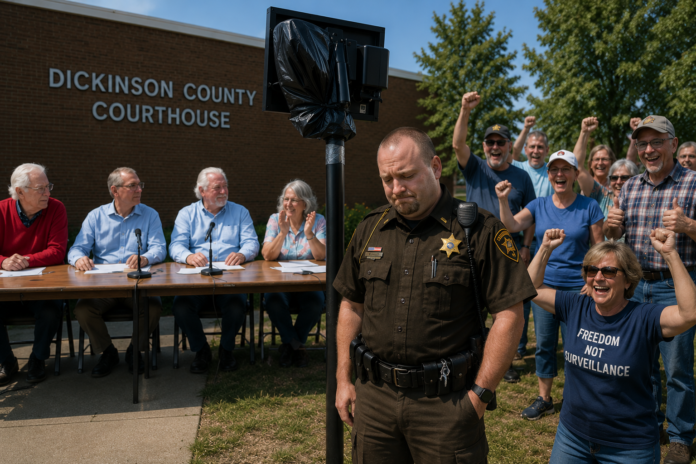
IRON MOUNTAIN — After discovering that Upper Peninsula residents are apparently willing to tolerate mosquitoes, potholes, six months of winter and Wisconsin drivers — but draw the line at a camera photographing their license plate — Dickinson County’s controversial Flock surveillance experiment is coming to an end.
Sheriff Aaron Rochon confirmed that the K.I.N.D. Drug Enforcement Team has decided to discontinue its Flock Safety license-plate reader program, bringing an abrupt conclusion to an experiment that managed to turn eight roadside cameras into the hottest political issue in Dickinson County since somebody last suggested changing the deer season.
The cameras had been purchased with drug-forfeiture funds and positioned around the county to assist law enforcement investigations. Rochon told local media that information from the system had helped authorities remove an estimated $50,000 worth of illegal drugs from the community.
Residents acknowledged that sounded nice, but several remained uncomfortable with the minor detail that the government had quietly constructed a searchable database showing when and where their vehicles had traveled.
The controversy boiled over at the July 13 Dickinson County Board meeting, where residents delivered a crash course in exactly how poorly the phrase “automated government surveillance network” plays in the Upper Peninsula.
Pam Trask of Breitung Township called the system “a slippery slope to a police state” and reminded commissioners that residents had not consented to being surveilled. Kirk Chartier called the cameras an “abuse of power,” while Eric Wysocki compared the potential for misuse to electronic stalking.
Commissioner Victoria Jakel said she was leaning against continuing the system, while Board Chairman Dan Harrington summed up the issue with the considerably less dramatic but probably more useful question: “What is the tradeoff?”
Meanwhile, Iron Mountain resident Joshua Arnold launched an online petition calling for Dickinson County to ban Flock cameras and other automated license-plate readers entirely.
Then something unusual happened in local government.
Officials listened.
Rochon spoke with several opponents following the county meeting, brought the concerns back to the K.I.N.D. executive board, and the board ultimately decided to terminate the Flock contract. Financial concerns were also cited, since the drug team relies heavily on forfeiture revenue and apparently concluded that committing future money to a surveillance system that half the county wanted to attack with garden tools was not ideal long-term budgeting.
By early August, Rochon said the cameras had been disconnected internally and externally and would eventually be physically removed.
That last part is important.
Because Facebook remains unconvinced.
“When they have a worker with a sawzall out there I’ll believe they are shut off,” one commenter wrote after news of the decision spread online.
Another resident offered an even more concise policy recommendation:
“GET THE FLOCK OUT!!!”
Others celebrated the decision, thanked officials for listening, or immediately began worrying that the cameras would simply be hidden somewhere else. One commenter warned, “They’ll just hide them now,” proving once again that removing a surveillance camera is significantly easier than removing suspicion from Facebook.
The discussion eventually expanded beyond Flock to Axon cameras, Bluetooth signals, cloud-based surveillance, Wisconsin cameras pointed toward Michigan, drones, streetlights and various other technologies that, by the end of the thread, left open the possibility that the decorative clock downtown may also be gathering intelligence.
Not everybody joined the revolt.
“Aren’t these cameras for catching criminals? Fighting crime is bad?” one commenter asked.
Another lengthy response argued that license-plate readers can help locate missing children and criminals and that communities shouldn’t reject useful technology simply because it can track vehicles.
That argument failed to calm everyone.
One resident suggested that even putting bags over the cameras wouldn’t be enough. Another wanted Wisconsin to point its cameras away from the Michigan border. And somebody else suggested Glad trash bags might be particularly well suited for holding the pieces of an “uninstalled” Flock camera.
For now, however, Dickinson County motorists can return to driving around without wondering whether a solar-powered camera on a pole is taking notes.
The cameras are disconnected. The contract is being terminated. The public has been heard.
And somewhere in Dickinson County, a Sawzall sits fully charged, waiting for independent verification.